







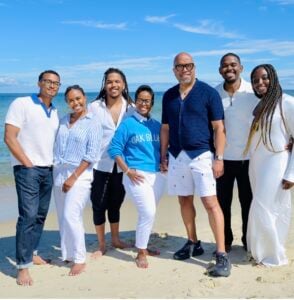


I grew up in Western Massachusetts, and my goal was two-fold: never live in my hometown again and write for The New York Times. I accomplished the first by going to college and never looking back. By 2008, I achieved the second goal, becoming a columnist at The Times. Things were going great professionally. Personally, I got married in 2007, and we had our first daughter in 2009, and our second in 2012.
The next year, my wife, Laura, said she wanted to start her own firm. I said, “You absolutely have to do that.” She said it would be “full on” and asked what we’d do with the kids. I said, “I’ll become the Lead Dad.”
At the time, that term was just an inside joke, meaning I’d take on the logistics of parenting—the mental load. But I did it undercover in my town; most caregiving was done by moms or nannies. I also didn’t want to tell my editors at The Times that I wasn’t 100% committed to my career. I was an undercover lead dad for seven years.
COVID changed everything. Suddenly, we had three children at home while my wife and I were both working extremely busy jobs. I thought there must be a way for me to get support as a fully involved father. While there was endless advice for moms and even aid for “dads in distress” (those struggling with divorce or addiction), there was nothing for the dad who was just trying to figure out how to be a supportive partner and a super-involved father.
As a journalist, I looked at the data. I found that about 25 million men in the U.S. are Lead Dads, and 23 million are in the workforce. This is a huge, untapped demographic. And then I talked to female executives with children about the role their husbands played in their lives as fathers and partners. There were two extremes – O.G. Lead Dads who got called Mr. Mom or the House Husbands, but whose wives and families flourished, and Detached Event Dads whose wives divorced them. The third group – the vast middle of mothers’ – said COVID showed them that while they love their husbands, their husbands don’t realize the full extent of the mental load. They needed a “Lead Dad Boot camp.”
With the encouragement of my wife, I left The New York Times at the end of 2021 and launched The Company of Dads to serve this growing demographic.
Chief Operating Officer
There are two, actually. The smaller one is that my daughters, who are 16, 13, and 8, are hypocrisy-seeking missiles. They will call out when they catch us scrolling on our phones and say, “You need to be focused.” It’s a reminder that true multitasking is a myth, and stress happens when you try to be in two places at once.
The more systemic one is: If an event doesn’t exist on the family calendar, it doesn’t exist. We live by our shared family calendar. It helps you see the future, and as a parent, if you have any insight into the future, you have a leg up because you can be proactive and not reactive to what’s happening.
“Organize your way to Greater Happiness.”
It’s all in the word: organization. When you have things organized and know what’s happening, you can plan for the knowable things. You won’t be surprised by the same stupid stuff over and over again.
We swore we’d always have dinner at the same time, together, every night. We still have family dinner most nights, but my older two are not getting home until 7:30 and the youngest needs to be in bed around that time. We’ve had to be flexible with the logistics. However, one thing we’ve never waivered on is that our kids eat what we eat. If we’re having salmon, they’re having salmon.
The only soundtrack that plays in my head all the time is Taylor Swift’s complete discography. What else would it be in a girl dad house?
Working and parenting taught me how to be hyper-organized and to stop procrastinating. It’s not a luxury when you want to be successful at both. At The Company of Dads, we talk about the “care shift”—designating certain hours for synchronous work and other hours for solo, focused work. I apply this to my life: 9-2 is when I interact with people, and the other hours, like late at night or when waiting in the car, are for deep thought or mundane tasks. This taught me to get ahead of things, reducing stress and increasing the likelihood of success in both domains.
It’s made me more empathetic. When I was younger, I understood balancing work and life was difficult, but I didn’t truly appreciate it. Now, as a father of three (one of whom has learning challenges), I’m more empathetic to all working parents. I tell companies: don’t just focus on your top performers. The vast middle is the bedrock. If you can give them grace in a moment where they are being pulled in a different direction—be it parenting or caregiving—they are more likely to stay and perform.
I didn’t like the presumption from other dads that they “don’t do that” or that their “wife does that.” It took a while, but I eventually got comfortable in my undercover role and started pushing back, saying, “Yes, I do that, and why don’t you?” Popular media does a horrible job of representing fatherhood; they fall back on tired clichés like the bumbling or absent father. We know from data that a third of all fathers are trying to be a different type of man, husband, and father. When I left The New York Times, the funniest misunderstanding was a hedge fund guy who congratulated me on “retiring” in my 40’s. I just had to push back and explain what I was really doing.

I define success as the LinkedIn messages, emails, or Instagram DMs I get from a guy I don’t know who says, “Man, I’m really glad you use this term ‘Lead Dad.’ That’s who I am, and I didn’t know how to define myself.” I get several of those a week, and that feels like true success.
We were in our 30’s when our children were born. We were both far enough along in our careers that we had some flexibility and ownership over our time, which is key. Had we had children earlier, when I was a deadline journalist for the Financial Times, it would have been really difficult. The time commitment of my wife starting her own business is also why there was a gap between our second and third child, and probably why we stopped at three.
I would have every workplace offer “Care Days” as a benefit, in addition to vacation, sick, and personal days. I’d add five to ten Care Days. It’s important because when you name something, it has power. When someone can openly say, “I am taking a Care Day,” it starts to promote a culture of openness and honesty. Employees are already doing their parenting things, whether they’re hiding it or not. By labeling it, you show that you care about the whole employee, and you put action behind the statement “We put family first.” And managers must take them, too, to show it’s okay.
We were woefully unprepared and naive, especially going from one child to two. My wife had a horrible boss who actually withheld part of her bonus to make sure she came back from leave. Instead of a corporate system, our support was built on our “all hands on deck” approach to marriage and family. We were hardwired to be very open and direct with each other. This is crucial to resentment. Resentment builds because one person begins to take on more and more, and they don’t communicate it until it becomes a serious problem. Our openness saved us.
Don’t suffer in silence. Be very open with your partner, of course, but also be really open with your manager. Take advantage of any policies your company offers. If you get pushback—if you lose the manager lottery and get some jerk who doesn’t honor your leave or makes you feel embarrassed—you need to look for another job. There are plenty of companies that really walk the walk and talk the talk. When you’re not open, you’re doing a disservice to yourself and your career. Being open and honest creates a long-term path for you to do both working and parenting to the best of your ability.