






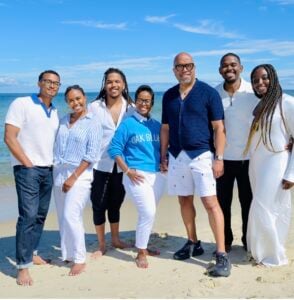


Hi! I was a VP of Strategy and Transformation for a professional services firm until 2022. After leading back-to-back organizational changes while parenting a toddler through the pandemic, I realized the common challenge in my strategy work was how difficult it was for people to change. That led me to pursue Georgetown’s Executive Coaching program, and I haven’t looked back!
Today, I work with leaders and teams facing a moment of transformation, which absolutely includes my Josie coaching clients, because becoming a working parent is one of the most transformational moments in a career.
When my son, Wesley, was three and I was working out of our basement during the pandemic, I told him it was time to start work. He looked at me and asked, “What happens if you DON’T do that?”.
That question has stayed with me and become one of my favorite things to ask my coaching and consulting clients. Too often, the default thinking is “more is better”—filling your schedule with a “gajillion meetings” and tasks that feel necessary but are often just habits. Think about those 90-page PowerPoint decks that go through ten rounds of editing and no one reads. Any time a client gets into that mindset, I channel Wesley and ask: “What happens if we DON’T do that?”.
It would be called “Weirdo Talent”. It’s about unlocking potential by embracing who people are and letting go of who we want or expect them to be. It’s about replacing “NO” with more “Why Not?”.
I’ve told my poor husband on more than one occasion that I’m strategy and he’s operations. So, I guess I’m either CEO or Chief Strategy Officer.
Part of this is due to my ADHD; you definitely don’t want me in charge of operations! But having ADHD also forces you to get really, really good at prioritization and finding shortcuts, since you can’t rely on brute-forcing your way through every item on the to-do list. I also find that so many of my work conversations center around, “What do you want this next chapter to look like?”. My brain naturally wants to go there, no matter what I’m doing.
As the daughter of a mother who was the PTO president from elementary school through high school, I swore I’d never do that.
Guess who is now the secretary of our PTO and up to her elbows in planning for Fall Fest next week? It’s been an incredible way to connect with other parents. It was a hard lesson to learn that for there to be a vibrant community at your school, someone actually has to make that happen.

There were two major things: First, I got significantly better at asking for help, delegating, and negotiating task scope. I no longer had the luxury of spending nights and weekends on things if I needed to be present with my family. It was incredibly uncomfortable at first, but it became a huge “unlock” for me. And secondly, I became a lot more understanding and protective of my team’s lives outside of work. I had more proactive conversations about what they wanted and needed, and I intentionally modeled taking that space myself. It was important to me that flexibility and boundaries be an “everyone thing, not just a parent thing”.
Having to learn how to manage the emotions of a toddler while simultaneously leading an organization through massive change was a phenomenal pairing from a skills perspective—if not from a work/life balance perspective.
Both roles involve being really patient and empathetic with people whose concerns might seem irrational or unreasonable. In both cases, the person is often being asked to do something that makes them uncomfortable, that they are not happy about, and is usually out of their control. Trying to rush people or tell them they should feel differently almost always backfires. People at all ages need space to work through hard feelings to get to a place where they can get on board with what’s coming next.
Success for me right now is having the energy and enthusiasm to do all the things that are important to me. That includes:
Generally, that means success also looks like taking care of myself from a rest and health perspective to make it all happen, and avoiding over-scheduling or “doom-scrolling”. When do I actually pull that off, life is pretty damn great.
Putting aside the obvious ones like bringing our paid family leave in line with other developed countries, or the four-day work week, my policy would be this: for ALL employees in good standing performance-wise, they would have the freedom to get their work done when and where it made sense to them.
All this “Return to Office” nonsense makes me so mad. People are adults. Trust them to behave like adults, and in 99% of cases, they will reward that trust in spades.