







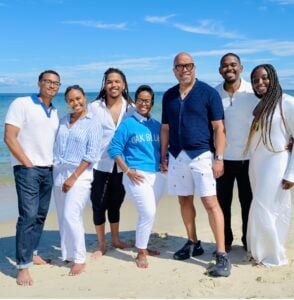

I’m a Minnesotan, a mom to an adult daughter, and a mental health professional who has also spent more than 30 years working in Corporate healthcare as a leader. Looking back, I realize how much of my professional and personal life has been shaped by transitions. When my daughter was a toddler, I was also caring for my aging and ultimately dying parents while trying to navigate daycare, work, and family medical leave. Years later, as my daughter was preparing to leave for college, I was entering menopause. In many ways, we were both navigating major developmental transitions at exactly the same time—just at very different stages of life. Those experiences have shaped how I think about people. We are rarely dealing with just one thing at a time. That perspective has become central to both my work and my parenting..
My daughter taught me that I don’t always need to be the solutioner. My natural instinct—both as a parent and professionally—is to see a problem and immediately start thinking about how to fix it. Parenting taught me that sometimes the more valuable response is to slow down, listen, validate and ask, “What do you think you want to do?” or “What are your options?” That doesn’t mean I never offer guidance. Sometimes I’ll ask, “Okay, what’s Plan B? And if that doesn’t work, what’s Plan C?” But I try to help people think through their options rather than automatically solving the problem for them. That lesson has been invaluable at work. People often don’t need me to have the answer. They need me to help them find their own answer.
I would call it “Connection Before Correction.” I believe people generally do better when they feel understood, respected, and connected. That doesn’t mean there aren’t expectations, boundaries, or accountability. It means that those things work better when they come from a place of relationship rather than control. Parenting also taught me that behavior is communication. A toddler having a meltdown isn’t a “bad kid,” and the parent having a hard time managing the moment isn’t a “bad parent.” Someone is having a difficult moment. There is usually something underneath the behavior worth understanding. I’ve carried that philosophy into leadership: get curious before getting critical.
I think my title would be Director of Emotional Logistics. Parenting involves an astonishing amount of emotional logistics—keeping track of everyone’s needs, schedules, relationships, developmental stages, and the things nobody remembered to tell you about! Now that my daughter is an adult, the job description has changed. I’m learning that being a parent of an adult means knowing when to offer advice, when to ask questions, and when to simply be there. The role evolves. You never really stop being a parent; you just have to keep learning how to parent the person in front of you.
I swore I would never tell another parent how to parent. The irony is that before I had a child, I had a bachelor’s degree in Child Development, so naturally I thought I knew everything about parenting. My sister and brother in law had a daughter before I had my own child, and I was more than happy to point out all the things she was doing wrong and all the things she could be doing better. Then I had my own child. Let’s just say I am still apologizing to my sister and brother in law. Having my own child was a very humbling experience. I quickly learned that knowing what the textbook says and actually parenting a child are two very different things. You can understand child development, know all the “right” strategies, and still find yourself standing in the middle of a grocery store wondering what on earth you are supposed to do next. It completely changed the way I look at other parents. I became much less interested in judging someone’s parenting and much more interested in wondering, “What else might be going on here?” Parenting taught me that there is a tremendous difference between knowing better and doing better in a particular moment. We are all parenting with the information, energy, circumstances, and resources we have that day. I became much more humble about thinking I knew better.
And if my sister and brother in law are reading this, I am still sorry.
There is one moment with my daughter that I think about often. She had written a paper and asked me to review it and give her some feedback. I did what came naturally to me—I got out my proverbial red pen and essentially rewrote the paper. She looked at me and said, in so many words, “That’s not what I asked you to do. I didn’t ask you to fix it. I asked you to give me feedback and help me reflect on it.”
She was absolutely right. I realized in that moment that my instinct to help could actually get in the way of someone else’s learning. I had taken over a process that belonged to her. She didn’t need me to make her paper better. She needed me to help her think about what she had written and decide for herself what she wanted to change.
That moment changed something for me professionally as well. I realized how often, as a leader or helping professional, we can fall into the role of solutioner because we genuinely want to help. But if we are always solving the problem, we can unintentionally take away someone’s opportunity to develop confidence, judgment, and their own problem-solving skills.
Now I try to pause before jumping in with an answer. Instead, I might ask, “What are you thinking?” “What do you see as your options?” “What would Plan B look like?” or “What would you like to do differently?” I still believe there are times when people need direction, expertise, or a clear answer. But I have learned to distinguish between helping someone and taking over for them.
Becoming a parent made me much more aware that people are always carrying more than what we see.
As I shared, when my daughter was young, I was simultaneously parenting, working, managing daycare, and caring for parents who were dying. That experience permanently changed the way I look at other people’s lives. Someone can walk into work looking completely fine while carrying something enormous outside of work.
It made me a more empathetic leader, but I don’t think empathy means lowering expectations. I believe you can have high standards and still recognize that people are human.
It also changed my decision-making. I became more interested in helping people think through options rather than simply giving them answers. I want people to leave a conversation with me feeling more capable, not more dependent on me.
I have actually been very fortunate throughout my career to have had managers who were understanding and supportive of the realities of being a working parent. I recognize that not everyone has had that experience, and I don’t take mine for granted.
What I have come to understand, though, is how easy it is for all of us to misunderstand another parent when we don’t know what is happening in their life outside of work.
I reflected on when my daughter was young, I was balancing parenting with caring for my own parents as they became ill and eventually died. There were daycare schedules, family medical leave, work responsibilities, and the emotional weight of caring for one generation while raising another. There were probably days when I looked perfectly capable on the outside while feeling completely stretched on the inside.
That experience taught me the importance of grace.
I try to remember that everyone is coming into a moment with a different amount of energy, capacity, support, and resources. What someone is able to manage today may be very different from what they could manage yesterday—or what they will be able to manage tomorrow.
I think we sometimes judge people based on the moment we are seeing rather than the whole story we don’t know.
That has made me much more intentional about extending grace, especially to other parents. A child having a meltdown doesn’t make them a bad child, and it doesn’t make the parent a bad parent. Sometimes everyone has simply reached the limit of what they have available in that moment.
Success for me right now is about meaning rather than simply achievement.
My daughter is an adult now, and I find myself in a different season of life. I want to continue doing work that matters, continue growing professionally, and also make room for relationships, creativity, learning, travel, and the things that genuinely bring me joy.
I’ve also become more comfortable with the idea that life doesn’t have to look the same in every season. When my daughter was young, success meant getting everyone where they needed to be and making it through the day. Now success feels more like being intentional about how I want to spend my time and what I want to contribute.
I’m asking less, “How much can I accomplish?” and more, “Does this matter to me?”
I would create a “Life Happens” policy that recognizes caregiving and significant family needs as part of being human rather than an inconvenience to the organization.
I would want a workplace culture where reasonable flexibility is not interpreted as a lack of commitment. In fact, I think flexibility can help people remain committed and productive over the long term.
People don’t leave their lives at the door when they walk into work. Good organizations understand that.
For me, family and career were never completely separate paths. They were happening simultaneously, and sometimes they competed for my attention.
During my daughter’s early years, I found myself in the middle of a unique season of life—raising a young child while my own parents’ health was declining. I was learning to navigate the competing demands of motherhood, career, and caregiving, while also experiencing the emotional complexity of watching my parents’ lives change. It was a season that taught me a great deal about priorities, flexibility, and accepting that sometimes there simply isn’t a way to give everything your full attention at the same time.
Years later, my daughter was preparing to leave for college at almost the same time I was entering menopause. It struck me that we were both experiencing major transitions—she was beginning a new chapter and I was entering a very different one.
Those experiences shaped my trajectory in ways I couldn’t have planned. They taught me that careers and families don’t always unfold according to a neat timeline. Sometimes you adjust, sometimes you pause, sometimes you move forward, and sometimes you simply get through the season you’re in.
I don’t see those experiences as interruptions to my career anymore. They became part of what shaped the professional and personal perspective I bring to my work.
For me, it really came down to planning, communication, and building a reliable support system. I had to be intentional about arranging childcare, understanding and using family medical leave when I needed it, communicating with my manager about what was happening, and making sure responsibilities were covered while I was away.
I also learned that a support system has to be bigger than one person. Family, childcare providers, colleagues, and supportive managers each played an important role at different times. When you are balancing a young child with other family responsibilities, having people you trust to step in, help problem-solve, or simply provide reassurance makes a tremendous difference.
When I returned to work, I found it helpful to give myself some time to reestablish routines rather than expecting everything to immediately feel normal. I had to become comfortable with planning ahead, asking for help when I needed it, and being willing to adjust when the plan didn’t work.
One of the most important resources, though, was learning to communicate clearly about what I needed. I was fortunate to have understanding managers, and that taught me how important a supportive workplace can be during major life transitions.